- Trade School Secrets
- Posts
- This chart explains why the education system is broken and why trade schools are the solution no one wants to admit.
This chart explains why the education system is broken and why trade schools are the solution no one wants to admit.
We reached 2500 subs - so blessed to share this journey with you all. Thank you.
Sponsored by

How Jennifer Aniston’s LolaVie brand grew sales 40% with CTV ads

The DTC beauty category is crowded. To break through, Jennifer Aniston’s brand LolaVie, worked with Roku Ads Manager to easily set up, test, and optimize CTV ad creatives. The campaign helped drive a big lift in sales and customer growth, helping LolaVie break through in the crowded beauty category.
Take 10 seconds and look at this:
From 2000 to 2021:
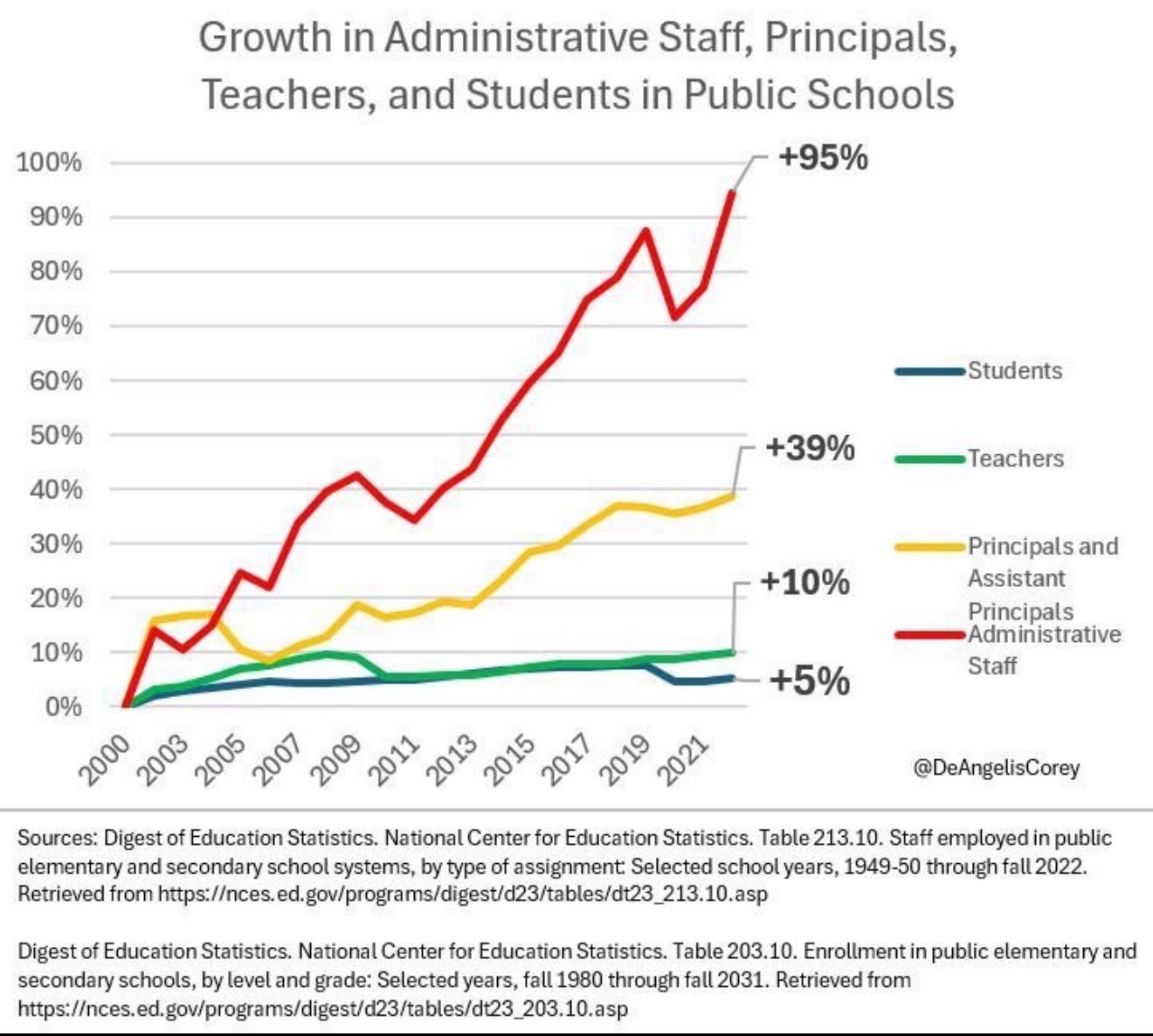
Administrative staff: +95%
Principals: +39%
Teachers: +10%
Students: +5%
Read that again.
The number of people managing the system exploded.
The number of people being educated barely moved.

What People Think Is Happening
Most people believe:
Schools are underfunded
Teachers are stretched thin
Class sizes are the main issue
We just need to “invest more”
That’s the narrative.
And on the surface, it sounds right.
But this chart tells a completely different story.
What’s Actually Happening
The system didn’t grow.
It expanded sideways.
Instead of investing in:
Skills
Outcomes
Career pathways
Real-world readiness
We added layers:
More administrators
More oversight
More compliance
More structure
But not more results.
We built a system that got bigger…
Without getting better.
Why This Matters for the Trades
Now connect this to what you and I see every day.
While traditional education was adding administrators…
The trades were losing workers.
While schools focused on structure…
Employers were begging for skill.
While students were told to follow the same path…
The job market was quietly shifting underneath them.
The Gap No One Wants to Talk About
Here’s the uncomfortable truth:
We didn’t just underinvest in trades.
We over invested in everything else.
And now we’re dealing with the consequences:
Massive labor shortages
Delayed infrastructure projects
Rising service costs
Employers training from scratch
Entire industries aging out
This didn’t happen overnight.
It was 20+ years in the making.
Why WIOA Exists (And Why It’s Not Going Anywhere)
This is exactly why programs like WIOA exist.
Not as a backup plan.
But as a correction mechanism.
Because when traditional systems fail to produce:
Skilled workers
Job-ready candidates
Career mobility
Something has to step in.
WIOA does three things the traditional system doesn’t:
Funds outcomes, not time spent
Aligns directly with employer demand
Creates fast pathways into real jobs
It’s not perfect.
But it’s necessary.
And necessary systems don’t disappear.
What Smart Operators See That Others Don’t
Most people look at this chart and see a problem.
Smart trade school operators see a once-in-a-generation opportunity.
Because when a system drifts this far from outcomes…
The correction is never small.
It’s structural.
That means:
More funding toward skills
More pressure on outcomes
More reliance on alternative pathways
More opportunity for operators who can execute
The Shift Is Already Happening
You don’t need a headline to see it.
You see it when:
Employers partner directly with schools
Workforce boards push for faster training models
Students question the ROI of college
Parents start looking for alternatives
The market is correcting in real time.
What This Means for You
If you’re building or thinking about building a trade school, this is the lens you need:
You’re not competing with other schools.
You’re stepping into a gap created by a system that lost its way.
And the operators who understand that—
who build around outcomes, not optics—
are the ones who will win over the next decade.
Final Thought
This chart isn’t just about education.
It’s about misalignment.
Too much structure.
Not enough skill.
Too many layers.
Not enough outcomes.
That gap doesn’t stay open forever.
It gets filled.
The only question is who fills it.
Until next time, control what YOU can control, take action on something, and don’t forget to smile. Like what you read? Here’s how you can help: Share this newsletter with friends who could use a boost.
Sharing is caring! Connect with me on X (formerly Twitter) – let's chat and support each other. Find me at @Trade Schools Secrets-WIOA Whisperer (https://link.mail.beehiiv.com/ss/c/u001.NbFuuwrtVixC8Mrf9ptxWPFTyHDJSKDjK8e4SiFVNG2reUm4WnA7xtBzxLoOtWj3axNA33kzNBRJPXJYMwXXF6bpcDrkWs1tRqSACEtUaX